
Passenger vehicle wholesales in India declined 2.5 per cent year-on-year to 341,510 units in July, impacted by high base effect as well as companies reducing vehicle dispatches to dealers amid moderation in demand. The overall passenger vehicle (PV) dispatches from companies to dealers stood at 350,355 units in July 2023, automobile industry body Siam said on Wednesday.

'There's a misconception that all Rs 1 lakh crore will be spent immediately, leading to higher consumption of FMCG goods, travel, and vehicle purchases.' 'While some of this money will go toward consumption, not all of it will.' 'The impact depends on where people deploy their savings.'

Automobile, apparel and electronics are among sectors that see a sales boost during the festival season, a time when investors expect gains in related stocks. This year could be different: Analysts have factored in all positives and do not expect such stocks to deliver lucrative returns. "Indian households spend across sectors like automobiles, consumer durables, and consumer staples during the festival season.

Wedding planner WedMeGood estimates that the average wedding budget has surged to Rs 36.5 lakh this year, with destination weddings averaging Rs 51 lakh.

Sales of diesel-powered utility vehicles have been declining in the past six months as the differential between petrol and diesel prices narrowed.

'Wherever the government has provided incentives for the purchase of two-wheelers, three-wheelers, cars, buses, and trucks, it gets a push for most of these alternate fuels. '

The benchmark National Stock Exchange Nifty has rallied 4 per cent, or 750 points, from this month's low to end at 19,732 on week ending November 17. Technical analysts say the market could consolidate around the current levels as it is nearing the resistance zone. "The near-term uptrend status of the market remains intact, but there is a possibility of some more consolidation or minor weakness for the Nifty in the next one to two sessions.

With sentiment for the automotive (auto) sector turning positive, stocks of two-wheeler auto majors have been hitting their 52-week highs. Hero MotoCorp, Bajaj Auto, TVS Motor Company, and Eicher Motors recently reached their yearly highs on strong sales in the festival season and the expectation of faster growth rates ahead. Since the start of this month, listed two-wheeler majors have delivered returns in the 12-17 per cent range, compared to the 7 per cent gains for the S&P BSE Auto Index and 3 per cent for the benchmark S&P BSE Sensex.

'Asset allocation should be driven much more by long-term factors rather than the market scenario at any particular point in time.'

Companies like Flipkart, Amazon and Meesho as well as quick commerce ones like Blinkit, Zepto and Swiggy Instamart may create hundreds of thousands of seasonal jobs for the coming festival season.

Operating margins have been the primary driver of corporate earnings in India in recent quarters, despite revenue growth suffering from weak consumer demand. Companies across sectors have reported a sharp improvement in earnings before interest, tax, depreciation, and amortisation (Ebitda) margins over the past two years, benefiting from lower commodity and energy prices. Higher margins more than compensated for slower revenue growth, resulting in double-digit growth in net profit for five consecutive quarters.

More than 50 per cent of SIP accounts come from semi-urban and rural areas.

'The customer is fast changing, and she demands newer experiences that wealth can buy.'

The stock of consumer goods major Emami has corrected nearly 3.5 per cent since its 52-week high of Rs 546.25. On August 29, the stock closed at Rs 521.90 on the BSE. After underperforming the Nifty FMCG index for a long time, the stock is now doing a catch up and surged over 13 per cent in the past one month.

'Our target will come from rural areas as there are more outlets there.'

The finance ministry has cautioned that global and regional uncertainties and domestic disruptions may keep inflationary pressures elevated in the coming months, warranting "greater vigilance" by the government and the Reserve Bank of India (RBI). "Russia's decision to terminate the Black Sea grain deal, along with dry conditions in major wheat-growing areas, caused a price spike in cereals. Domestic factors like white fly disease and an uneven distribution of monsoon exerted pressure on vegetable prices in India," the ministry said in its latest Monthly Economic Report for July, released on Tuesday. However, the report maintained, the recent price surge in certain food items "is expected to be transitory". "Tomato prices are likely to decline with the arrival of fresh stocks by the end of August or early September.

Although large companies like Nestle, Dabur or HUL have been impacted by this slowdown in demand, it was the small, local players that have been hit harder.

'We are confident that over the next few years the government will strike a fine balance between populist measures and growth, and manage coalition partners well.'

With Onam and Raksha Bandhan just around the corner, the festival season is ready to kick off in full swing. As people embrace the celebratory spirit, companies anticipate a surge in sales this year. Consumer durables firms are expecting strong growth of 40-50 per cent in the premium segment during the upcoming season. Appliance makers also foresee increased demand for cooling appliances - refrigerators and air conditioners - which were impacted by unseasonal rainfall.

Sanjiv Mehta, chairman of the country's largest consumer goods company, HUL, believes that the second wave of the Covid-19 pandemic between April and June this year has been a mere pause in India's consumption story, and that it will not change the country's overall growth trajectory. India is poised for growth, especially in the fast-moving consumer goods (FMCG) sector, Mehta told shareholders at the company's annual general meeting on Tuesday. The signs of recovery are becoming evident with many states lifting lockdown restrictions in recent weeks.

A third of FMCG sales and half of motorcycle sales come from the hinterlands

The finance minister clarified that indexation benefits offered until April 1, 2001 would be protected. This means older properties, including legacy assets, would benefit.

Kurumbur in gold-loving Tamil Nadu was once a thriving centre for goldsmiths. Today their number is down to two.

Reserve Bank on Thursday retained the growth and inflation projection at 7.2 per cent and 4.5 per cent respectively for the current fiscal amid expectations of a normal monsoon. In its last bi-monthly monetary policy review in June, RBI had projected real GDP growth and retail inflation at the same.

Automobile retail sales in India rose to a record high in November, aided by the best ever monthly performance across passenger vehicle and two-wheeler segments, dealers' body FADA said on Wednesday. The overall retail sales stood at 28,54,242 units last month, 18 per cent higher over 24,09,535 units in November 2022. Passenger vehicle (PV) retail sales rose to 3,60,431 units as compared to 3,07,550 units in the year-ago period, registering a growth of 17 per cent.

A 15 per cent corporate tax rate for services companies in SEZs, setting up a fund for deep-tech startups and establishing clusters to demonstrate design-to-manufacturing capabilities of tech firms were some of the key demands made by the IT sector at the pre-Budget consultation on Monday. The participants shared their views and suggestions regarding Big Data, incentives for encouraging setting up of data centres, fiscal incentives for data localisation, incentives for pushing digital penetration in rural areas, and corporate guarantee to startups for competing with other nations.

Deloitte India on Friday said it estimates India's GDP growth at 6.6 per cent in the current fiscal helped by consumption expenditure, exports rebound and capital flows. In its India's economic outlook report, Deloitte said the rapid growth of the middle-income class has led to rising purchasing power and even created demand for premium luxury products and services. With the expectation that the number of middle-to-high-income segments will be one in two households by 2030/31, up from one in four currently, we believe this trend will likely become further amplified, driving overall private consumer expenditure growth, it said.

India Inc on Thursday pitched for lowering income tax burden on common man, increase in capital expenditure, and firm steps to contain food inflation in their nearly two-hour long interaction with finance minister Nirmala Shitharaman ahead of the Union Budget. During pre-Budget consultation with Sitharaman, the industry leaders and associations also urged the government to focus more on infrastructure development with a view to maintaining the economic growth momentum. The industry leaders also laid stress on boosting the MSME (micro, small, and medium enterprises) sector, considered a backbone of the Indian economy and main employment generator.

The nearly Rs 15,000-crore India unit of Coca-Cola derives the bulk of its revenue from its core business of selling cola drinks

If the forecast materialises, it would mean the fourth successive quarter of economic growth below 5 per cent.
ITC Ltd on Friday reported a 23.09 per cent increase in consolidated net profit at Rs 5,070.09 crore for the third quarter ended December 2022, helped by growth momentum across its operating segments. The diversified company had posted a net profit of Rs 4,118.80 crore during the October-December quarter of the previous fiscal, ITC said in a regulatory filing. Its revenue from operations was up 3.56 per cent to Rs 19,020.65 crore during the quarter under review, as against Rs 18,365.80 crore in the corresponding period of the previous fiscal.

Higher disposable incomes, rural push and infra push to boost auto sector

India's overall retail inflation eased to 4.41 per cent in September, helped by falling commodity prices, but rural inflation was at 5.05 per cent
As the second wave of the Covid-19 pandemic abates, India's automakers are hopeful of a quick recovery in sales volumes, led by better rural sentiment, low interest rates, improved availability of finance and a gradual uptick in business and economic activity. In fact, companies have started to ramp up production already, encouraged by high order books and the growing preference for private transport in both rural and urban areas as a means to avoid infections. In early April, the industry had been bullish as the sales trend for March showed that the effects of the Covid-19 pandemic had been left behind. The total vehicle sales had grown by 77 per cent, albeit on a lower base, and for the past few months, sales had consistently touched 300,000 units per month.

The Maharashtra police has so far registered 141 cases in connection with the violence during the Maratha quota agitations and arrested 168 persons, state Director General of Police Rajnish Seth said on Wednesday.

India's electric two-wheeler (E2W) sector is expected to cross the one million mark in 2024 fuelled by rising demand, increased production, and affordability, industry experts said, even as several original equipment makers are expanding their penetration to rural areas. Improved battery technology and innovative features are also likely to fuel growth, they said. "E2W sales will breach the 1-million mark in 2024 as the demand for electric two-wheelers is expected to continue growing due to factors such as environmental awareness, government incentives, and improvements in technology," Hyder Khan, chief executive officer (CEO), Godawari Electric Motors, said.

Market linking of petrol and diesel prices has helped the industry.

Data captured in central government records have a lag.

Paytm plans to induct 5,000 manufacturers and sellers; has started programmes to identify and train new sellers.
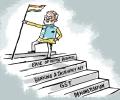
India's GDP expanded 13.5 per cent in the April-June quarter, the quickest pace in a year, to retain the world's fastest growing economy tag but rising interest costs and the looming threat of a recession in major world economies could slow the momentum in the coming quarters.
